
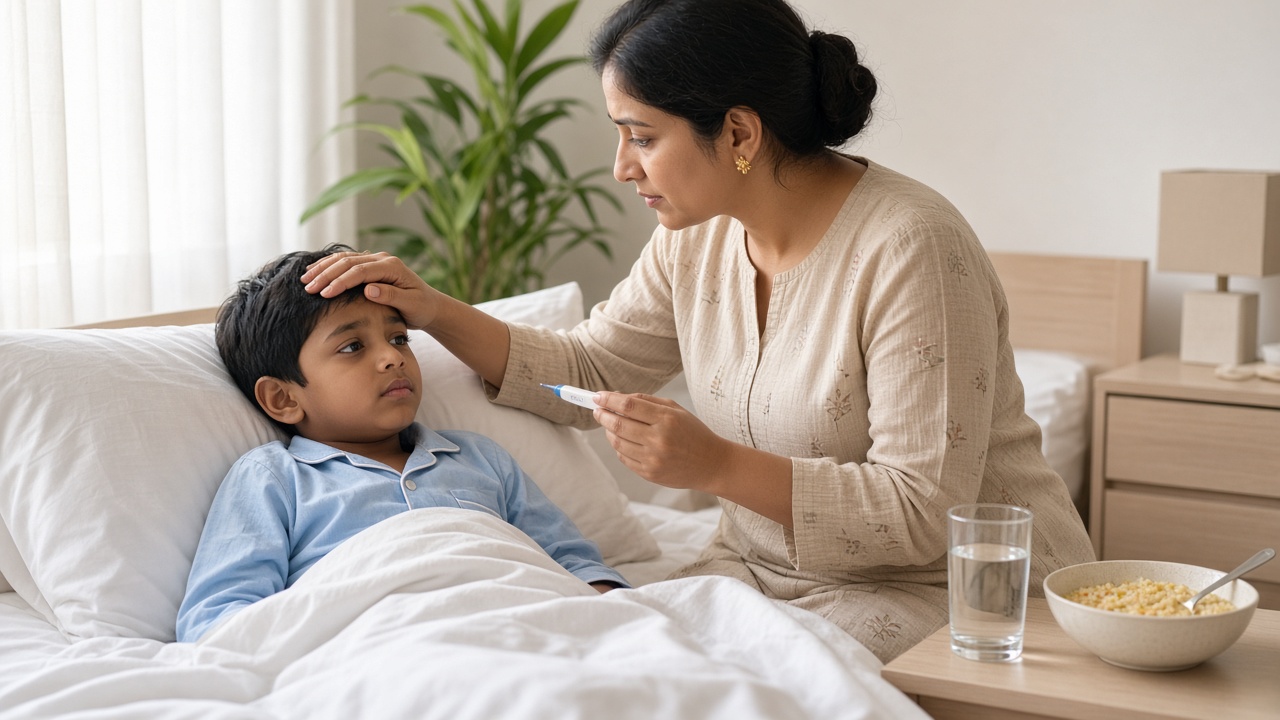
Every October, parents in my clinic ask the same question about a fever that has lasted four or five days: “Doctor, is it typhoid?” Typhoid is still common in Hyderabad, and Telangana’s health department reported a slight rise in cases this year even as dengue and malaria fell.
Quick answer: Typhoid is a bacterial infection that spreads through contaminated water and food. It usually shows up as a fever that climbs over several days, with tiredness, stomach pain and poor appetite. A blood culture, not a Widal test alone, confirms it, and the right antibiotic for the full course cures most children. A single dose of the typhoid conjugate vaccine from 6 months of age, plus safe water and handwashing, is the best protection.
- Key fact: Typhoid is caused by Salmonella Typhi; paratyphoid, a similar illness, is caused by Salmonella Paratyphi.
- Key fact: In a large Indian study, children aged 5 to 9 years had the highest rates of typhoid at most sites.
- Key fact: The Indian Academy of Pediatrics (IAP) calls blood culture the gold standard test. A Widal test can be falsely positive, so it should not decide treatment on its own.
- Key fact: IAP recommends one dose of typhoid conjugate vaccine (TCV) at 6 to 9 months, with catch-up for older children.
What is typhoid and how do children catch it?
Typhoid (also called enteric fever) spreads by the faecal-oral route. The germ passes in the stool of an infected person and reaches a child through water, ice, juices, cut fruit or food that has been contaminated. In my practice, pani puri, roadside juices and unsafe drinking water after pipeline repairs or heavy rain are common culprits. A large Indian surveillance study (SEFI) found typhoid in roughly 6 of every 1,000 children each year across its community sites, with the highest rates in cities. Data reported by The Times of India showed that Telangana accounted for nearly one in five of India’s recorded typhoid deaths in 2023.
What are the symptoms of typhoid in children?
According to the IAP Standard Treatment Guidelines on enteric fever, symptoms differ by age:
- Under 5 years: fever with vomiting and loose stools, which can look like an ordinary stomach bug.
- Older children: a fever that climbs step by step over 5 to 7 days, loss of appetite, stomach pain, headache, cough, tiredness, and sometimes constipation instead of diarrhoea.
- On examination: a coated tongue, a tender tummy, or a slightly enlarged liver or spleen. The “rose spot” rash described in Western textbooks is almost never seen in Indian children.
Typhoid, dengue, malaria and viral fevers look alike in the first few days, so I do not label every fever as typhoid. For dengue, see my guide to dengue warning signs and blood tests.
Which test confirms typhoid: blood culture or Widal?
Blood culture is the test that confirms typhoid. It works best in the first week of fever (it picks up about 90% of cases then) and before any antibiotic is started. It also shows which antibiotics will work.
The Widal test looks for antibodies and only turns positive in the second week. The IAP guideline notes that it can be falsely positive after malaria, rickettsial fever or other infections, and falsely negative if antibiotics have already been given. Because many people in Hyderabad already carry antibodies, a “positive” Widal during a viral fever season often misleads, a concern Hyderabad doctors raised again in August 2026. Rapid kits such as Typhidot share these problems.
How is typhoid treated?
Most children can be treated at home with oral antibiotics; those who are very unwell, vomiting or dehydrated need hospital care and injections. What I stress to families:
- Use only the antibiotic your pediatrician prescribes, for the full course. IAP advises treatment for at least 7 days after the fever settles, or 14 days in total, whichever is longer (azithromycin courses are shorter).
- Expect the fever to take a few days to settle. Even on the right medicine, it is common for fever to continue for 4 to 7 days. Please do not switch antibiotics on your own.
- No quinolone antibiotics. IAP advises that they should not be used to treat typhoid in children.
- Keep your child eating and drinking. Offer plenty of fluids such as ORS, water, buttermilk and soups, and soft, freshly cooked home food like idli, khichdi, dal-rice and curd rice. There is no need to starve a child with typhoid.
- Use paracetamol for comfort, dosed by your child’s weight, and avoid ibuprofen unless your doctor advises it.
Even after good treatment, typhoid can come back (a relapse) in about 5 to 20% of children, usually 2 to 3 weeks later. If fever returns, come back to your doctor.
How can I protect my child from typhoid?
- Vaccinate. The IAP immunization schedule (2025) recommends a single 0.5 mL dose of typhoid conjugate vaccine from 6 months of age (ideally at 6 to 9 months), and currently no booster. Older children and teenagers who missed it can still get it. The vaccine does not protect against paratyphoid and is not 100% effective, so hygiene still matters.
- Drink safe water. Use boiled or properly purified water, and boil water whenever your area’s supply has been disrupted.
- Wash hands with soap before eating and after using the toilet, and teach children to do it every time.
- Be careful with outside food, especially in the festival season ahead: skip pani puri, cut fruit, raw salads, ice and uncovered juices from roadside stalls. Hot, freshly cooked food and a water bottle from home are safest.
For more on keeping children well after the rains, read my rainy season health guide.
When to see a doctor urgently
See a pediatrician if your child’s fever lasts more than 2 to 3 days. Go to a doctor or emergency department immediately if your child has:
- Severe or worsening stomach pain, or a swollen, hard tummy
- Vomiting everything, or signs of dehydration (very little urine, dry mouth, no tears, sunken eyes)
- Blood in the stool or black, tarry stools
- Unusual drowsiness, confusion, or a seizure
- Fast or difficult breathing, cold hands and feet, or yellow eyes
- Fever that is not improving after 5 to 7 days of antibiotics, or a fever in a baby under 3 months
If your child has had fever for several days and you would like them checked, I see children at Cygnet Clinic, Czech Colony, Hyderabad, from 7:30 to 9:30 PM, Monday to Saturday, by appointment. You can book a visit here.
Frequently asked questions
Can a positive Widal test alone confirm typhoid?
No. A Widal test can be positive after other infections or past exposure, and negative early in the illness. Blood culture, ideally taken in the first week before antibiotics, confirms typhoid.
How long does it take for typhoid fever to settle after starting antibiotics?
Even with the right antibiotic, fever often takes 4 to 7 days to settle. Finish the full course, and return if your child looks worse or the fever has not eased after about a week.
My child had the typhoid vaccine. Can they still get typhoid?
Yes, but it is much less likely. The vaccine gives good protection, but it is not 100% effective and does not cover paratyphoid, so safe water and handwashing still matter.
What should my child eat during typhoid?
Keep feeding your child: soft, freshly cooked home food such as idli, khichdi, dal-rice and curd rice, with plenty of fluids. Small, frequent meals are easier when appetite is low.
When can my child go back to school after typhoid?
Usually once the fever has been gone for a couple of days, your child is eating well and your pediatrician agrees. Keep up strict handwashing during recovery.
This article is for general information and parent education, not personal medical advice. Please consult a qualified pediatrician about your child’s symptoms, tests and treatment.
Sources: Indian Academy of Pediatrics, Standard Treatment Guidelines 2022: Enteric Fever; IAP ACVIP Recommended Immunization Schedule (2025), Indian Pediatrics 2026;63:311-324; John J, et al. Burden of Typhoid and Paratyphoid Fever in India (SEFI). New England Journal of Medicine, 2023; The Hindu: Typhoid cases rise slightly in Telangana (August 2026); Telangana Today: Hyderabad doctors warn Widal test may cause typhoid misdiagnosis (August 2026); The Times of India: Every fifth typhoid death in country is from Telangana (February 2026); World Health Organization fact sheet: Typhoid.



Leave a Reply