
Reflections from my Point of consultation
As pediatricians, we often encounter situations that fit neatly into established medical guidelines. A child has fever, we investigate the cause. A child has pneumonia, we follow evidence-based treatment protocols. A child suffers a dog bite, we assess the rabies risk according to well-defined recommendations.
But occasionally, a patient arrives with a story that falls somewhere between the lines of the textbook.
Recently, I encountered one such case that reminded me that medicine is not merely the application of guidelines. It is also the art of navigating uncertainty, understanding human emotions, and helping families make difficult decisions when there is no perfectly defined answer.
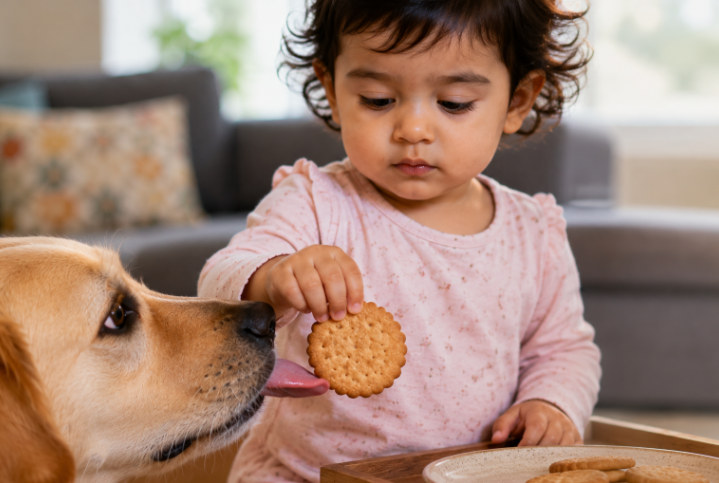
A 20-month-old girl was brought to my clinic after an unusual incident. Earlier that day, she had eaten a snack that had been licked by a pet dog. The dog itself had been purchased by the family only three days earlier, and they had been informed that the animal had received its rabies vaccination on the day it was acquired.
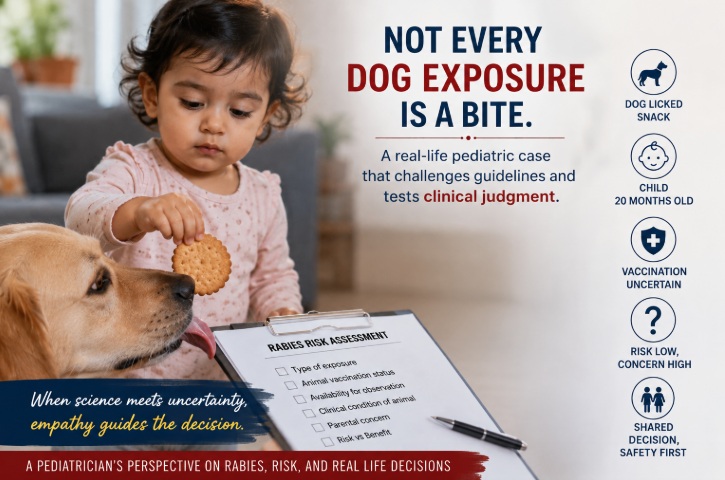
The parents were understandably worried.
Their concern was simple and direct: “Doctor, should our child receive rabies vaccination?”
At first glance, the answer may seem obvious. Yet the more carefully I analyzed the situation, the more I realized that this was not a scenario that comfortably fit into any standard category of rabies exposure.
Rabies is one of the most feared infectious diseases known to medicine. Despite tremendous advances in healthcare, once clinical symptoms appear, survival remains exceedingly rare. This reality is why both healthcare professionals and parents approach any potential rabies exposure with great caution.
Most rabies prevention guidelines focus on clearly identifiable exposures such as bites, scratches, or saliva entering broken skin or mucous membranes. Organizations such as the World Health Organization (WHO) Rabies Programme and India’s National Centre for Disease Control (NCDC) provide structured approaches to risk assessment that have helped save countless lives.
However, this child’s situation was different.
There had been no bite. There was no scratch. There had been no direct licking of an open wound. Instead, there was an indirect exposure involving a food item that had potentially come into contact with canine saliva before being consumed by a toddler.
From a scientific perspective, the likelihood of rabies transmission in such a scenario is extraordinarily low. In fact, indirect transmission through food contaminated with saliva is not considered a common or recognized route of human rabies infection. Based on available evidence, the probability of disease in this child was extremely close to zero.
Yet medicine is rarely practiced in the world of probabilities alone.
The challenge with rabies is that even when the probability is vanishingly small, the consequences are devastating. For parents sitting in a consultation room, the discussion is not about percentages or epidemiological statistics. The discussion revolves around a much more personal question: “What if my child is the exception?”
As physicians, we often focus on disease risk. Parents, naturally, focus on outcome risk.
The distinction is important.
When the outcome under discussion is a universally fatal disease, even an incredibly remote possibility can generate significant anxiety. During our consultation, I spent considerable time discussing the nature of rabies transmission, the available scientific evidence, and the reasons why this exposure was unlikely to result in infection.
At the same time, I acknowledged the realities that made this case somewhat uncomfortable from a clinical perspective.
The dog had only recently been acquired. Its vaccination history was based on information provided by a previous owner. The exact degree of saliva contamination was impossible to determine retrospectively. Furthermore, the exposure itself was sufficiently unusual that it did not fit neatly into traditional classification systems.
In situations like these, medicine enters a gray zone where clinical judgment becomes as important as guideline interpretation.
One of the most significant developments in modern healthcare has been the movement toward shared decision-making. Rather than simply instructing families on what must be done, physicians increasingly work alongside patients and parents to evaluate risks, benefits, uncertainties, and personal preferences before reaching a decision together.
After a detailed discussion, the parents repeatedly emphasized that they wished to pursue the safest possible option available for their child.
Importantly, they understood that rabies was highly unlikely. They understood that the exposure did not resemble the classical situations that typically warrant post-exposure prophylaxis. Nevertheless, their primary concern was achieving maximum risk reduction in the face of uncertainty.
Taking into account the unusual nature of the exposure, the inability to completely verify all circumstances surrounding the animal, and the family’s strong preference for the most conservative approach, we ultimately decided to initiate rabies post-exposure vaccination while simultaneously advising strict observation of the dog for at least ten days.
Some may argue that vaccination was unnecessary. Others may believe it was the prudent choice. In truth, reasonable clinicians could potentially arrive at different conclusions while reviewing the same case.
What I find most interesting about this encounter is not the vaccination itself, but what it reveals about everyday medical practice.
The public often imagines medicine as a discipline where every question has a precise answer and every decision follows a predetermined pathway. In reality, many clinical decisions involve balancing incomplete information, uncertain risks, parental concerns, practical realities, and the values of the people involved.
This is particularly true in pediatrics, where our patients cannot advocate for themselves and parents must often make difficult decisions on their behalf.
The case also highlights something we sometimes overlook in discussions about evidence-based medicine: emotions are not the enemy of rational decision-making. Fear, anxiety, and uncertainty are natural human responses. Good medical care does not dismiss these emotions. Instead, it acknowledges them, provides context, and incorporates them into a thoughtful decision-making process.
As I often tell parents visiting my clinics through VRA Health and those seeking pediatric guidance through Best Pediatrician India, the goal is not merely to treat disease. The goal is to help families make informed decisions with confidence and clarity.
This little girl will almost certainly never remember the incident. Her parents probably will. I certainly will.
Because every once in a while, a case comes along that reminds us that medicine is not simply about diagnosing illnesses and prescribing treatments. It is about helping people navigate uncertainty when life presents situations that do not fit neatly into any textbook chapter.
And perhaps that is where the true art of medicine resides.
Book an appointment with Dr Vannala Raju
Frequently Asked Questions by the Parents of my patients & my opinions:
Can rabies spread through food licked by a dog?
Rabies transmission through food contaminated by saliva is considered extraordinarily unlikely and is not a recognized common route of infection. Most human cases occur following bites or direct exposure of saliva to broken skin or mucous membranes.
Should every child exposed to a dog receive rabies vaccination?
No. The need for vaccination depends on the type of exposure, the health and vaccination status of the animal, local public health recommendations, and an individual risk assessment performed by a healthcare professional.
Why do doctors sometimes recommend vaccination even when the risk appears low?
In rare situations involving uncertainty, unusual exposures, incomplete information, or significant parental concern, clinicians may consider a more conservative approach after discussing risks and benefits with the family.
What should parents do after any unusual animal exposure?
Seek prompt medical evaluation, gather as much information as possible about the animal involved, and follow the advice of qualified healthcare professionals regarding observation and preventive treatment.


Leave a Reply